
Tire Choice, Code-60 Racing, and What We Learned at NCM
Over the last few weeks, we received thoughtful feedback from teams regarding our tire change rule. A few competitors raised concerns that a softer, faster tire will be a significant advantage over a harder compound that can last a full 7-hour race. This would inherently create an unfair advantage for teams that can spend more on tires.
We appreciate those conversations as they give us an opportunity to step back and evaluate things carefully. Rather than rely on theory, we went testing.
The series recently made an investment into a BMW M4 GT4 (G82) so we can gather real data regarding our rule set. This allows us to test our theories, create baselines, and hold ourselves and competitors accountable to the rules. We spent time at NCM Motorsports Park with the M4 GT4 and driver Matt Million (former BMW M Racing Academy driver) to better understand how two common 200TW tires behave over time: the Yokohama A052 and the Continental ExtremeContact Force.
The goal was straightforward: measure peak pace, measure degradation, then understand how that performance interacts with a Code-60 race format.
A Reminder on the Tire Rule
Our tire rule is intended to keep strategic options open while maintaining balance. Each car is permitted to change one tire during a race with no penalty. If more than one tire is changed during a pit stop, or if any additional tires are changed after the initial free tire change, a one-lap deduction is applied.
In practical terms:
• First single-tire change: no penalty
• Any stop involving more than one tire: one-lap deduction
• Any additional tire change later in the race: one-lap deduction
This framework (if balanced) allows teams to address issues or manage strategy while ensuring that no single approach can dominate purely through repeated fresh tire cycles.
Why Code-60 Changes the Math
Zenith operates under Code-60 procedures rather than traditional full course yellow racing.
In many FCY-based championships, when a caution comes out, the field compresses and pit stops can be made with limited time loss, often with time gained due to the compression of the field behind the safety car. If you stop at the right time, you can effectively get a free tire change.
Code-60 works differently. Even when the race is neutralized, the field continues and gaps remain constant. Cars circulate at a fixed reduced speed, and while pitting under Code-60 is advantageous over green-flag running, there is still a time penalty for pitting. Additionally, the race resumes without bunching up the pack.
What We Measured at NCM
We gathered roughly three hours of meaningful running between baseline and extended stints.
At peak, the Yokohama A052 was clearly quicker:
• Continental fast lap: 2:12.400
• Yokohama fast lap: 2:10.241
• Difference: 2.16 seconds
But when we evaluated representative long-run averages, the gap narrowed over time.
First 30 minutes (new tire window)
Average advantage: approximately 1.65 seconds per lap vs. Continental
Minutes 30 to 60
Average advantage: approximately 1.19 seconds per lap
Beyond one hour (plateau phase)
Average advantage: approximately 0.48 seconds per lap, once modest Continental degradation (+0.3 sec/lap after 30 minutes) was considered.
The largest drop occurred early in the stint. After about an hour, the Yokohama stabilized at a steady pace (about 1.8 seconds off its peak around the 3.1-mile track). It remained quicker, but by a smaller and more predictable margin.
Modeling a Seven-Hour Race
After collecting real data, we extended the scenario into a seven-hour race model. This model assumes the Yokohama strategy requires a stop at the midpoint of the race (210 minutes in). Additionally, the stop happens under Code-60, which effectively minimizes the total time loss to 18 seconds for the tire change (calculated assuming a 55-second tire change and the field circulating at one-third the average speed around the race track).
When the race is modeled using those numbers, we find the following:
• The Yokohama gains meaningful time during the early phase of each stint
• Continues to gain at a reduced rate during the plateau phase
• Then gives back 150 seconds during the tire change
Over the full seven-hour window, the net modeled result is that the Yokohama strategy with one stop finishes approximately 7 seconds behind a Continental no-stop scenario. In other words, once realistic stop time loss and our one-lap deduction are applied, the two approaches are nearly even. That is the type of outcome we hope to see: different paths, similar overall competitiveness.
Why We Allow Tire Choice
We believe allowing competitors to choose their tire improves the racing experience. Some teams prioritize peak performance, enjoy the extra grip, and are comfortable managing a stop. Some prefer durability and simplicity. Some make decisions based on available budget, testing familiarity, or driver feedback. Our role as a series is not to dictate preference. It is to create a structure where different choices can compete on equal footing. The combination of Code-60 racing and the current tire rule is designed to provide that balance.
What Comes Next
While we feel like we learned a tremendous amount at NCM, we also recognize this test was the first step. We need to collect further data and information in different environments to continue refining our rules. The biggest area we were not able to get data on at NCM is our slick tire data. Additionally, we would like to gather data at a track that has very different characteristics than NCM so we can validate the results in a different environment.
As such, we are heading to Barber Motorsports Park this weekend again with the G82 to gather data primarily focused on the following:
• Revalidate peak performance comparisons between Continental and Yokohama A052
• Understand the peak performance delta of the Pirelli slick vs. the above-mentioned compounds
• Gather degradation data on the slick compound and model it into our seven-hour race format
We will have a similar report as this one released early next week after our findings on the slick tire data, so be sure to tune into our socials and announcement page on the Zenith website to stay up to date. After the Barber test, we also plan to gather further data with the series vehicle at Sonoma Raceway for our season opener on March 12–15.
Our goal is to make informed decisions based on multiple tracks, compounds, and vehicles. Based on the initial findings above, we plan to maintain our tire change regulations for the first event at Sonoma. However, if new information is found with the slick testing at Barber, we will make any necessary changes quickly before heading into Sonoma.
We are very excited to see a range of strategies play out at Sonoma, and pending that data, we feel confident we will be able to make necessary adjustments. Thank you all for the engaging discussions, and we cannot wait to see you in four short weeks in California!
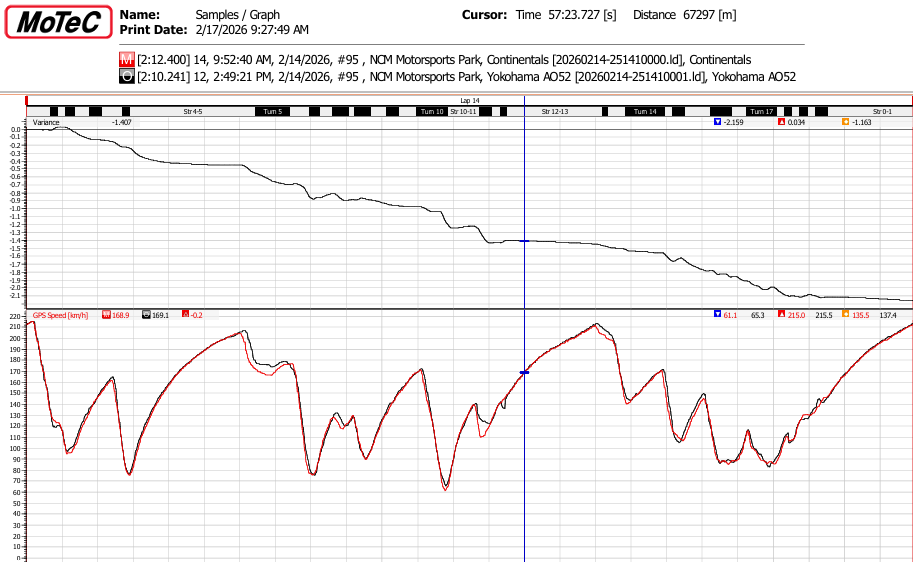
Yokohama Fast Lap (Black Trace) vs. Continental Fast Lap (Red Trace)
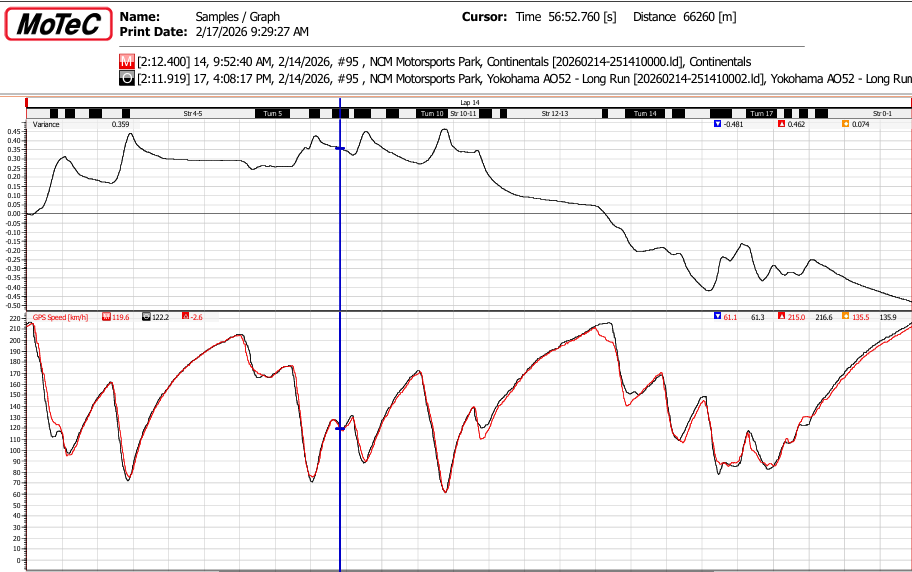
Yokohama Plateau Pace (Black Trace) vs. Continental Fast Lap (Red Trace)
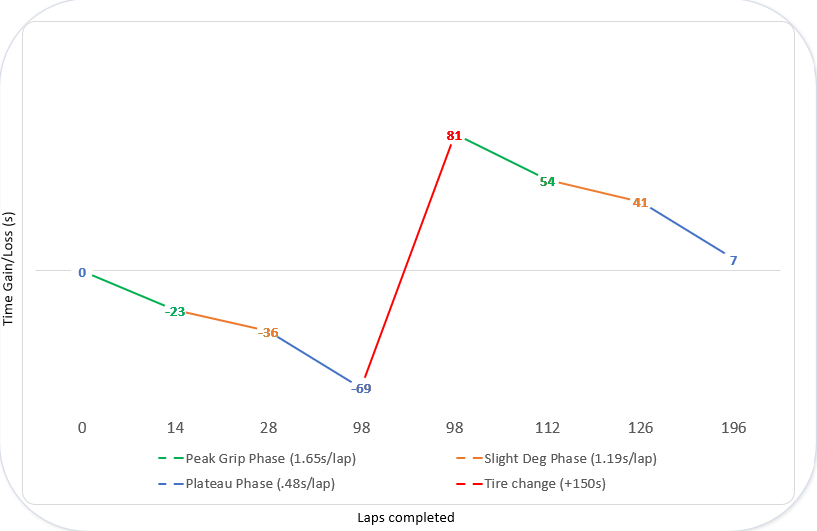
X-Y Plot of time gain/loss of Yokohama cs. Bridgestone over 7 hour race with a tire change at 3.5 hours into the race.